
Mutual funds (MFs) - flush with cash amid record inflows in July - invested heavily in the Rs 25,000-crore qualified institutional placement (QIP) of India's largest lender State Bank of India (SBI). Fund managers acquired SBI shares worth Rs 10,200 crore last month, making the lender their biggest buy in July.
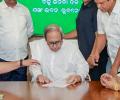
BJD chief Naveen Patnaik has voiced concerns over the Centre's decision to introduce Merchant Discount Rate (MDR) charges on UPI transactions above Rs 2,000 from October 15, urging protection for small traders and common people. This move has sparked a political debate, with the BJP defending the charges as beneficial for digital infrastructure and largely not impacting consumers, while the Congress and traders' associations criticise it as an additional burden.

Indian benchmark indices, Sensex and Nifty, experienced declines in early trade due to a significant surge in crude oil prices, exacerbated by escalating tensions in the West Asia. Track how Sensex, Nifty fared on July 23.

The Supreme Court of India has quashed criminal proceedings against Standard Chartered Bank and one of its officers in a 1991-92 Foreign Exchange Regulation Act (FERA) case, citing an extraordinary 23-year delay in prosecution and the Enforcement Directorate's failure to comply with mandatory procedural safeguards.

A think tank, GTRI, has urged India to resist US pressure regarding its UPI policies, advocating for the defence of competition, policy autonomy, and the long-term sustainability of its payments ecosystem. This comes as the Lok Sabha passed a bill allowing charges on UPI transactions, a move GTRI suggests should not be influenced by foreign trade complaints.

Former Haryana Chief Minister Bhupinder Singh Hooda has criticised the newly introduced fees on UPI payments, stating they will lead to increased inflation for the common man. He dismissed government claims that customers would not be burdened, arguing that merchants would pass on the costs. Hooda demanded the immediate withdrawal of these fees, highlighting that the government's move contradicts its 'Digital India' initiative.

State Bank of India has launched a suite of AI-powered digital innovations on its YONO platform, enhancing both retail and business banking services. These new features include a 3-in-1 digital onboarding process, a sustainability tracker, integrated trade finance, and an AI virtual assistant, aiming to provide intelligent and future-ready banking experiences for its 53 crore customers.

The Congress party has criticised the Modi government over a notification regarding UPI transactions, alleging it paves the way for imposing fees, especially on transactions above Rs 2,000. Rahul Gandhi claimed the government is surrendering to American pressure, while Mallikarjun Kharge highlighted the potential burden on common citizens amidst inflation. The government's notification prohibits charges on UPI transactions up to Rs 2,000 but remains silent on higher amounts, sparking fears of a "Digital Payments Tax."

National Investment and Infrastructure Fund Limited (NIIF) has appointed Gauravjit Singh as managing partner to lead its global capital formation efforts. Simultaneously, PB Fintech's payment aggregator platform, PB Pay, has gone live, offering consolidated payment acceptance for merchants. In a move to enhance trade efficiency, the Directorate General of Foreign Trade (DGFT) has introduced open API integration for Certificate of Origin, allowing exporters to streamline their application processes.

Private corporations in India invested approximately 30.3 trillion in fixed assets during FY25, marking a 7 per cent increase from the previous year, according to the statistics ministry. This growth in private capital expenditure contrasts with a slowdown in government capital spending.

The Congress government in Karnataka has issued an order limiting the singing of 'Vande Mataram' to its first two stanzas at state programmes, with exceptions for events attended by high-ranking officials. This decision, based on a 1937 Congress resolution, has drawn sharp criticism from the opposition BJP, which labels it "appeasement politics" and an insult to the national symbol.

The FCNR (B) stratagem relies on using public money to defend the rupee. The State subsidises foreign borrowing to attract dollars. This tool requires large-scale borrowing to make a material difference against a gross external flow of $11 billion a day. A commensurately large fiscal cost falls upon the exchequer. The ministry of finance will choose how much it is willing to spend in exchange for this round number, points out Ajay Shah.

The CBI has registered a case against Reliance Capital Limited (RCAP), its former chairman Anil Ambani, and others for an alleged Rs 2,684.57-crore fraud. The case stems from a complaint by the Life Insurance Corporation of India (LIC) regarding investments in RCAP's non-convertible debentures, alleging criminal conspiracy, misrepresentation, and fraudulent diversion of funds causing significant loss to LIC.

The Congress party has criticised the government's new 0.4% charge on UPI transactions above Rs 2,000 for merchants, terming it a "Modi tax". Opposition leaders, including Rahul Gandhi and Mallikarjun Kharge, allege that this move will ultimately burden consumers through price hikes and accuse the government of succumbing to American pressure to dilute India's zero-MDR policy. The government states the charge will support banks and fintechs.

Change of guard in some states and evolving El Nino dynamics are triggering fresh actions on raging water-sharing disputes in several states.

UIDAI Chairman Neelkanth Mishra announced the extensive deployment of Artificial Intelligence to detect and counter fraud in Aadhaar, describing it as a "cat-and-mouse game." He highlighted the dramatic increase in daily Aadhaar authentications and the launch of the Aadhaar Face Authentication SDK and Sandbox to enhance security and ease of integration for ecosystem partners.

Economists highlight that resolving domestic policy bottlenecks, particularly through land reforms and improving the ease of doing business, will be critical for Prime Minister Narendra Modi's 'next-generation reforms' and India's economic transformation towards its 'Viksit Bharat' vision for 2047.

Samajwadi Party president Akhilesh Yadav has criticised the BJP government's proposed Merchant Discount Rate (MDR) on high-value UPI transactions, calling it a "chungi" (tax) on digital payments. He alleged the move was an attempt to extract money from people's transactions, contradicting the government's goal of a trillion-dollar economy. The new UPI framework will impose a 0.4% MDR on person-to-merchant transactions above Rs 2,000 from October 15, with certain sectors having a flat Rs 5 MDR.

The Finance Ministry has refuted allegations that US pressure influenced the decision to levy a 0.4 per cent Merchant Discount Rate (MDR) on select UPI payments. The ministry clarified that the NPCI guidelines prioritise RuPay credit cards on UPI to promote domestic alternatives and ensure a self-sustaining revenue model for smaller domestic companies, countering claims of favouring foreign payment providers.

Prime Minister Narendra Modi's 76th birthday was celebrated with extensive programmes in Varanasi, his Lok Sabha constituency. Events included special prayers by 76 young priests, a milk 'abhishek' of the Ganga, and a significant 'Seva Sankalp' motorcycle journey from Varanasi to Vadnagar, Modi's birthplace, involving 500 participants. Several prominent political figures, including Defence Minister Rajnath Singh and Uttar Pradesh Chief Minister Yogi Adityanath, participated in the celebrations, offering prayers for Modi's health and India's progress.

The National Stock Exchange of India Ltd (NSE) has received regulatory approval from SEBI for its long-awaited Rs 30,000-crore initial public offering (IPO), positioning it to potentially become the country's largest-ever public issue.

Indian benchmark indices, Sensex and Nifty, saw early gains driven by lower crude oil prices and buying in Reliance Industries, even as the Reserve Bank of India maintained its benchmark policy rate for the fourth consecutive meeting, reinforcing confidence in the domestic economy.

Govind Dev Giri Maharaj, treasurer of the Shri Ram Janmabhoomi Teerth Kshetra Trust, acknowledged supervisory lapses at the Ayodhya Ram temple following alleged donation theft, but stated he would not resign as he does not consider himself personally at fault. He estimated the theft could be around Rs 3 crore and criticised SBI for not verifying employee credentials.
NPCI International and Uzbekistan's NIPC have partnered to enable UPI payments across Uzbekistan, allowing Indian tourists, business travellers, and students to make instant merchant payments using the UZQR code. This agreement, approved by RBI and CBU, integrates UPI with Uzbekistan's national payment system, HUMO, facilitating direct P2M payments from Indian bank accounts and reducing reliance on foreign exchange or international cards.
Tax experts clarify that merchants will pay 18% GST on Merchant Discount Rate (MDR) for UPI payments exceeding Rs 2,000, effective October 15. However, registered merchants can claim Input Tax Credit (ITC), mitigating the tax burden. This move is expected to generate significant GST revenue for the exchequer while funding payment infrastructure.

'The issue appears to be less about Chandrasekaran personally and more about the direction Tata Sons should take.'

The Securities and Exchange Board of India (Sebi) is reportedly 'close' to approving the National Stock Exchange's (NSE) initial public offering (IPO) draft documents, with an expected market debut by early next month. Sebi Chairman Tuhin Kanta Pandey also emphasised the regulator's focus on enhancing market resilience against evolving risks, including technology failures and the impact of artificial intelligence.

The BRICS summit in New Delhi brings together leaders from major emerging economies to address global challenges like trade disputes, geopolitical upheavals, and the economic impact of conflicts in Ukraine and West Asia. India, as chair, aims to position BRICS as an economic growth engine, focusing on the Global South's food, energy, and supply chain security. The summit also highlights the grouping's expansion and its growing influence in global governance.

A 68-year-old Mumbai resident was defrauded of Rs 7.21 crore by cyber criminals who threatened her with false accusations of money laundering and terror funding. The fraudsters coerced her into transferring funds to bank accounts and a cryptocurrency wallet after impersonating officials from various agencies.
CPI(ML) Liberation general secretary Dipankar Bhattacharya has strongly criticised the newly introduced Merchant Discount Rate (MDR) on select UPI transactions, labelling it a "UPI tax" and demanding its immediate rollback. He drew parallels with demonetisation, arguing that the new framework would negatively impact small shopkeepers, MSMEs, and ordinary citizens by increasing prices.

A Public Interest Litigation has been filed in the Supreme Court challenging the Centre's decision to impose a 0.4 per cent Merchant Discount Rate (MDR) on UPI person-to-merchant transactions exceeding Rs 2,000. The plea argues that the levy was introduced without adequate statutory safeguards, transparency, or public consultation, and questions its constitutional validity and potential adverse effects on merchants and consumers.

The question for the next 20 years is not whether India can become a $5 trillion or $10 trillion economy. Those are attractive targets, but the real question is whether India can create enough productive jobs, educate its children properly, make its cities liveable, and give hundreds of millions of people a substantially better life, asserts Ramesh Menon.
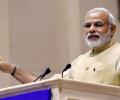
Prime Minister Narendra Modi, in his Independence Day address, highlighted technology and innovation as central to India's goal of becoming a developed nation by 2047. He called for India to lead in emerging technologies like AI, quantum computing, and space, announcing a massive AI skilling initiative for one crore youth. Modi stressed the importance of becoming a global innovation hub, bolstering energy security with nuclear power, and strengthening cybersecurity.

'... to see that young people are gainfully employed. After that, it will become very difficult as we will start ageing much more rapidly.' 'We have a huge proportion of Gen Z. After 2030, every year, we will start seeing a gradual shift towards a slightly older society.'

Indian benchmark indices closed marginally higher, with the Sensex gaining over 43 points and the Nifty remaining flat, as a spike in crude oil prices due to geopolitical uncertainties tempered risk appetite.

Reserve Bank Deputy Governor S C Murmu has highlighted the "cash paradox" where currency in circulation continues to grow despite a significant increase in digital payments. This trend complicates the RBI's forecasting and planning for currency production and distribution, prompting the central bank to seek solutions and explore ways to extend banknote life and reduce the carbon footprint of the cash cycle.
Indian stock market indices closed on a mixed note, with the Sensex gaining 374 points driven by buying in Reliance Industries and ICICI Bank, while the Nifty remained flat. This divergence is attributed to a new Closing Auction Session (CAS) mechanism introduced by stock exchanges, impacting market liquidity and price discovery.

'You can't have a runaway board that takes decisions against the active disagreement of the 66 per cent shareholder.'
'You can't have a runaway board that takes decisions against the active disagreement of the 66 per cent shareholder.'

Indian benchmark equity indices, Sensex and Nifty, experienced declines in early trade due to a surge in Brent crude oil prices, which rose above USD 90 per barrel, coupled with subdued global cues and ongoing US-Iran skirmishes. Track Sensex, Nifty on Auigust 12.
